

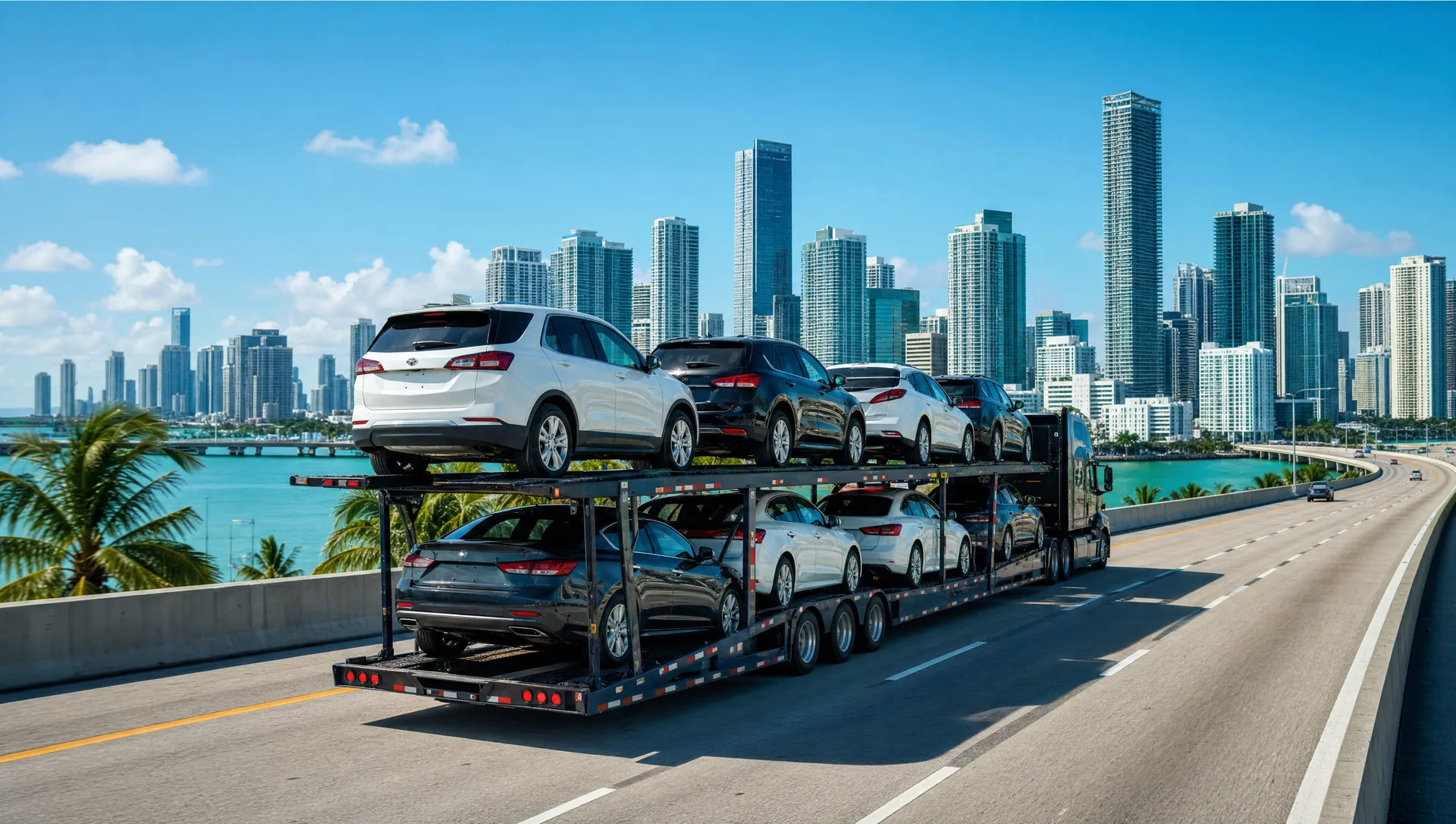
Open car transport in Miami
Open transport moves your car on an uncovered multi-car trailer — the same kind that delivers new vehicles to dealerships. Miami sits at the foot of the I-95 corridor, one of the busiest car-shipping lanes in the country, which is why open transport here is the most widely available and least expensive way to ship.
Quick answer: Published benchmarks for open transport run $0.70–$1.30/mi (standard sedan on an open carrier; Miami per-mile rates and national benchmarks).
Updated · sources linked below · providers set actual pricing
Open transport, easy as 1-2-3

Tell us the route and the vehicle
Both ZIP codes, the year, make and model, whether it runs, and your timing — about a minute, contact details last.

Providers quote your open-carrier spot
Independent providers running your route respond with real numbers for a place on an open trailer.

Pickup window, ride, delivery walkaround
Condition is documented at pickup, the car shares the trailer, and you inspect again before signing at delivery.
Who it suits
Is open transport right for your shipment?

Open transport is what most people end up choosing. Tell us the route and the vehicle and we can look for providers running it.
- Everyday vehicles being relocated for a move, purchase or seasonal trip
- Shipments where cost matters more than weather protection
- Routes between major metros, where open capacity is easiest to find
- Timelines with a few days of flexibility on either end
What actually happens
The parts people are surprised by
None of this is meant to put you off. It is the operational reality, and knowing it up front is what keeps a pickup from failing.
- 01
Your car shares a trailer
A typical open carrier holds seven to ten vehicles. Yours is loaded alongside others heading the same general direction, which is what keeps the per-vehicle price down. The trailer is uncovered, so the car is exposed to weather and road debris the same way it would be if you drove it.
- 02
Pickup happens in a window, not at a time
Providers work in pickup windows — often a one- to three-day range — because a driver is coordinating several vehicles along a route. You will normally get a call from the driver ahead of arrival to agree on a workable spot and time.
- 03
Loading needs room for a large truck
Full-size carriers cannot always reach a narrow residential street, a low-clearance garage or a gated complex. Drivers often meet at a nearby lot with room to maneuver. That is normal and is not a downgrade in service.
- 04
Condition is recorded at both ends
A bill of lading documents the vehicle condition at pickup and again at delivery. Both inspections matter — the delivery walkaround is your record if anything changed in transit, so do it before signing.
What open transport costs
Published estimates collected · standard sedan on an open carrier; Miami per-mile rates and national benchmarks
Published estimates
$0.70–$1.30/mi
$0.70–$1.30/mi
as published by A-1 Auto Transport (opens in a new tab)
Miami shipments; typical totals $800–$1,600
$0.96/mi average
as published by Automoblog (opens in a new tab)
national open-transport average from a secret-shopper study; typical totals $600–$2,500
≈$914 per shipment
as published by Move.org (opens in a new tab)
average open-transport price across roughly 800 quotes from 13+ companies
$0.33–$0.80/mi
as published by RoadRunner Auto Transport (opens in a new tab)
published per-mile table — about $0.80/mi under 500 miles, falling to $0.33/mi beyond 3,000
Per-mile rates fall as distance grows — the same published table that shows $0.80/mi on a short haul shows roughly a third of that coast to coast.
These figures are estimates published by third-party transport companies, shown here for orientation with their sources and collection date. They are not quotes from Car Shipping Miami or from providers on this marketplace, and they are not binding on anyone. Independent providers set their own pricing for your specific shipment.
Pricing
What moves the price on this service
We do not publish a number here, because there isn’t an honest one. These are the variables a provider is actually pricing against.
Route density
Busy corridors between large metros have far more carriers running them, so quotes tend to be lower and pickup windows shorter. Rural origins and destinations cost more because a driver has to leave the main route to reach you.
Vehicle size and weight
A compact sedan takes up less deck space and weight allowance than a lifted pickup or a three-row SUV. Larger vehicles displace paying freight, so they price higher on the same route.
Timing and flexibility
A wide first-available date is easier to fill than a hard pickup day. Flexibility usually reads as a lower price; a narrow window usually reads as a higher one.
Season and direction
Lanes swing with demand — snowbird season, auction cycles and the summer moving peak all pull capacity in one direction and push prices up on the busy side of a route.
Worth knowing
The trade-offs, stated plainly
Confident, not absolute — here is where this service has real limits.
Weather exposure is real, but limited
Cars on open trailers see rain, dust and road grime. Damage from that exposure is uncommon on a normal shipment, but if the vehicle is show-condition, rare or freshly painted, enclosed transport exists for a reason.
Top-load is a request, not a guarantee
Some providers offer a top-deck position for extra cost, which reduces road spray and any fluid drip from vehicles above. Whether it is available depends on the load the driver is already carrying.
Personal items are usually restricted
Most providers limit or prohibit personal belongings in the vehicle. Anything permitted is typically capped by weight and kept below the window line. Ask the provider directly — the rule is theirs, not ours.
Before a provider can quote
What we will ask you for
- Pickup and delivery ZIP codes
- Year, make, model and body style
- Whether the car runs and drives
- Your first available date and how flexible it is
Questions about this service
Is open transport safe for a normal car?
It is the standard method for the overwhelming majority of vehicle shipments, including the way manufacturers deliver new cars to dealers. The trade-off is weather and road exposure, not handling quality. Providers carry cargo insurance — ask any provider you speak with for their certificate and what it covers before you agree to anything.
How long does open transport take?
Transit time depends on distance, route and how quickly a provider can slot your vehicle into a load. Cross-country moves are commonly quoted in the range of a week to ten days once the car is picked up; regional moves are much shorter. Any provider you speak with should give you their own estimate for your specific route — treat that, not a website number, as the real answer.
Can I put belongings in the car?
That depends entirely on the provider. Many allow a limited amount of personal property in the trunk or below the window line; some do not allow any. Federal rules govern what carriers may haul, and items left in the vehicle are generally not covered by cargo insurance. Confirm the policy before pickup day.
Car Shipping Miami is a marketplace and advertising platform. Car Shipping Miami does not transport vehicles or provide transportation services. Transportation quotes and services are offered by independent providers. Review provider information and terms before choosing a service. How this marketplace works
Popular open transport routes from Miami
Ready to find a provider for your route?
Share the route, the vehicle and your timing. You’ll know exactly what happens next before you submit anything.
Get quotesCar Shipping Miami is a marketplace. Independent providers quote and perform the transport.