

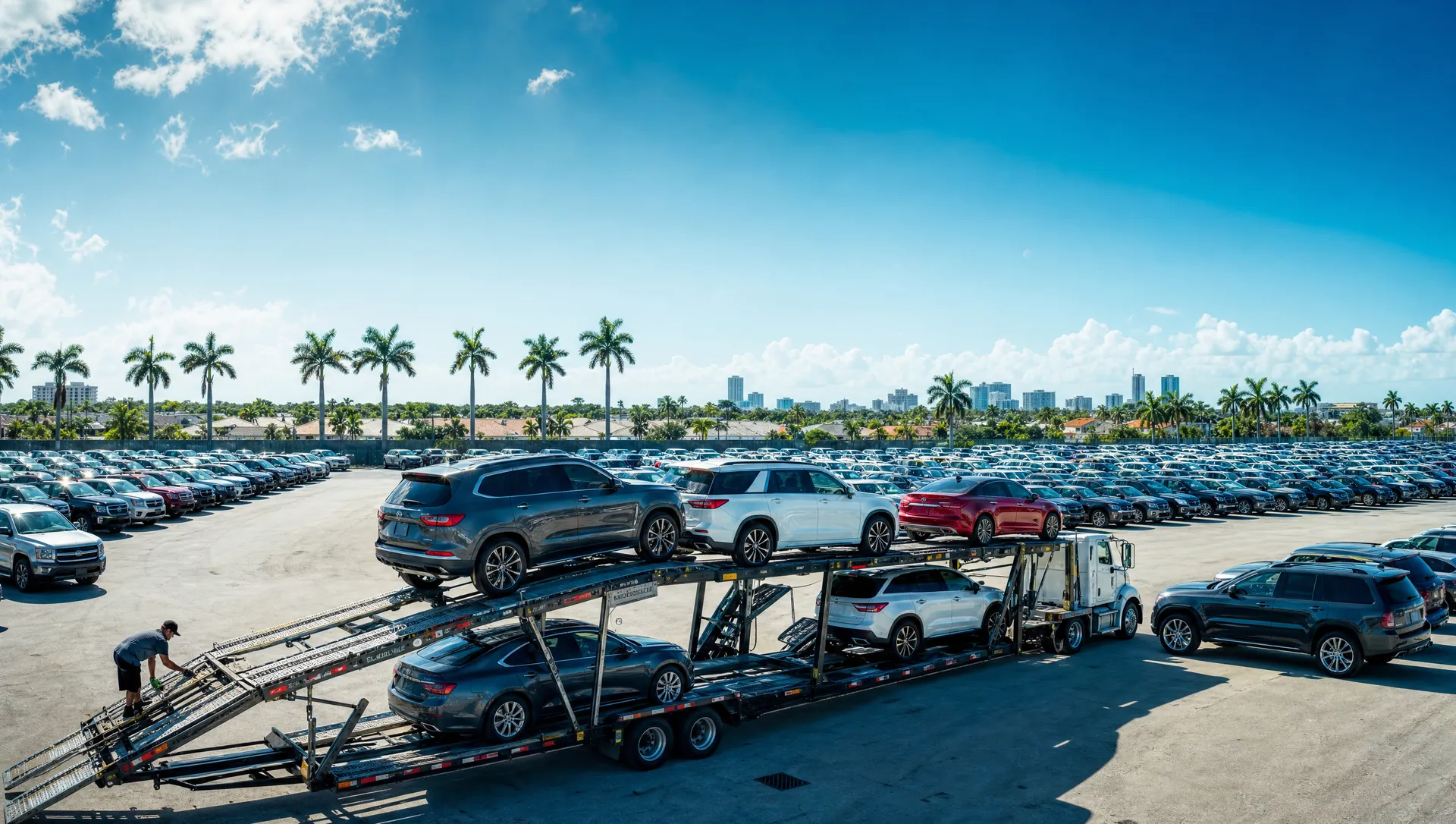
Auction car shipping in Miami
South Florida is ringed with auction facilities, and every one of them starts charging storage quickly. A pickup can stall for reasons that have nothing to do with the driver — a missing gate pass, an unpaid balance, or a buyer number that does not match. Getting the paperwork lined up first is most of the job.
Quick answer: Published benchmarks for auction & dealer purchases run $0.60–$1.50/mi (published rates for a running auction vehicle, plus published surcharges).
Updated · sources linked below · providers set actual pricing
Auction pickup, easy as 1-2-3

Tell us the lot, buyer number and condition
The facility, whether the balance is paid, and whether the car runs, rolls, steers and brakes — paperwork first.

Providers who work that facility quote it
Drivers who run auction lanes know the gate rules and loading hours, which is exactly what a fast release needs.

Gate pass presented, car off the lot
The driver presents the release tied to your buyer number, documents condition, and the storage clock finally stops.
Who it suits
Is auction & dealer purchases right for your shipment?

Auction pickups usually stall on paperwork, not trucks. Tell us the lot, the buyer number and whether the car runs, and we can look for providers who work that facility.
- Copart, IAA and other salvage or insurance auction purchases
- Manheim, ADESA and dealer-only auction buys
- Online marketplace purchases picked up from a dealership or storage lot
- Any purchase where storage fees are already accruing
What actually happens
The parts people are surprised by
None of this is meant to put you off. It is the operational reality, and knowing it up front is what keeps a pickup from failing.
- 01
The lot releases to a named party, not to anyone
Auction facilities release a vehicle only to a driver who can present the correct release or gate pass tied to your buyer number. If the name on the release does not match the driver or the transport company, the vehicle stays on the lot.
- 02
The balance has to be settled first
Most facilities will not release a vehicle with an outstanding balance, including buyer fees and accrued storage. This is the single most common reason a scheduled pickup fails.
- 03
Lots keep their own hours and rules
Auction yards have fixed loading hours, and some require an appointment. A driver who arrives after cutoff cannot simply wait — that becomes another storage day. Providers who run auction lanes regularly know the local rules, which is a fair thing to ask about.
- 04
Condition at pickup may be unknown to you
If you bought online, the driver may be the first person to see the vehicle in person. Ask the provider to document condition at pickup carefully; on salvage purchases this record matters more than on a normal shipment.
What auction & dealer purchases costs
Published estimates collected · published rates for a running auction vehicle, plus published surcharges
Published estimates
$0.60–$1.50/mi
$0.60–$1.50/mi
as published by Compare the Carrier (opens in a new tab)
running Copart vehicle; $50–$150 winch fee if it does not run
+$200 flat
as published by J&S Transportation (opens in a new tab)
published surcharge added to every Copart/IAA transport quote
Storage is the real clock — Copart late fees are published around $50+ per day, so a faster pickup often beats a slightly cheaper one.
These figures are estimates published by third-party transport companies, shown here for orientation with their sources and collection date. They are not quotes from Car Shipping Miami or from providers on this marketplace, and they are not binding on anyone. Independent providers set their own pricing for your specific shipment.
Pricing
What moves the price on this service
We do not publish a number here, because there isn’t an honest one. These are the variables a provider is actually pricing against.
Whether the vehicle runs and rolls
A salvage purchase that does not start, steer or brake needs winch-equipped equipment and more time on the lot. That is a different service and a different price than a drivable car — see non-running vehicle shipping.
Lot location relative to the route
Auction facilities are frequently on the edge of a metro, and a driver may have to detour off a main corridor to reach one. Distance from the interstate matters more here than on a residential pickup.
Urgency
When storage fees are accruing daily, buyers often pay more for a fast pickup. That is a legitimate trade — just do the arithmetic on daily storage versus the price difference before deciding.
Damage and dimensions
Missing wheels, a caved-in corner or a vehicle that cannot be steered all change what equipment is required and how the car can be secured on the trailer.
Worth knowing
The trade-offs, stated plainly
Confident, not absolute — here is where this service has real limits.
Storage does not pause because a truck is booked
Fees accrue until the vehicle physically leaves. Booking transport is not the same as stopping the clock — the release, the balance and the lot hours all have to line up too.
Some lots have a release deadline
Facilities may charge escalating fees or begin a disposal process after a set number of days. Check the deadline on your invoice and work backward from it.
We do not hold your buyer credentials
Car Shipping Miami passes your shipment details to a provider. The gate pass, the payment and the buyer account stay between you and the auction facility. Do not send account passwords or buyer logins to anyone, including a provider.
Before a provider can quote
What we will ask you for
- The auction facility, city and lot number
- Your buyer number and whether the balance is paid
- Whether the vehicle runs, rolls, steers and brakes
- The last day before additional storage or a release deadline hits
Questions about this service
How fast can a vehicle be picked up from an auction lot?
Once the balance is paid and a gate pass exists, pickup timing comes down to which providers already run that lot and how their route lines up. Facilities near major corridors move faster than remote ones. A provider can tell you their realistic window for that specific lot — that is the number to plan around.
What paperwork does the driver need?
Typically a gate pass or release form tied to your buyer number, and identification matching the transport company on the release. Requirements vary by facility. Confirm the exact document list with the lot directly, then make sure your provider has it before dispatch day.
The car does not run. Does that change anything?
Yes, significantly. It changes the equipment required, the loading time and the price, and it narrows the pool of providers who can take it. Say so at the request stage rather than at pickup — a driver who arrives with the wrong equipment cannot load the car, and you may be charged for the trip.
Car Shipping Miami is a marketplace and advertising platform. Car Shipping Miami does not transport vehicles or provide transportation services. Transportation quotes and services are offered by independent providers. Review provider information and terms before choosing a service. How this marketplace works
Popular auction & dealer purchases routes from Miami
Ready to find a provider for your route?
Share the route, the vehicle and your timing. You’ll know exactly what happens next before you submit anything.
Get quotesCar Shipping Miami is a marketplace. Independent providers quote and perform the transport.