
How long does it take?
Commonly quoted at 7–10 days once loaded. The route covers about 2,730 driving miles.

Car Shipping Miami is a marketplace. Independent providers quote and perform the transport.
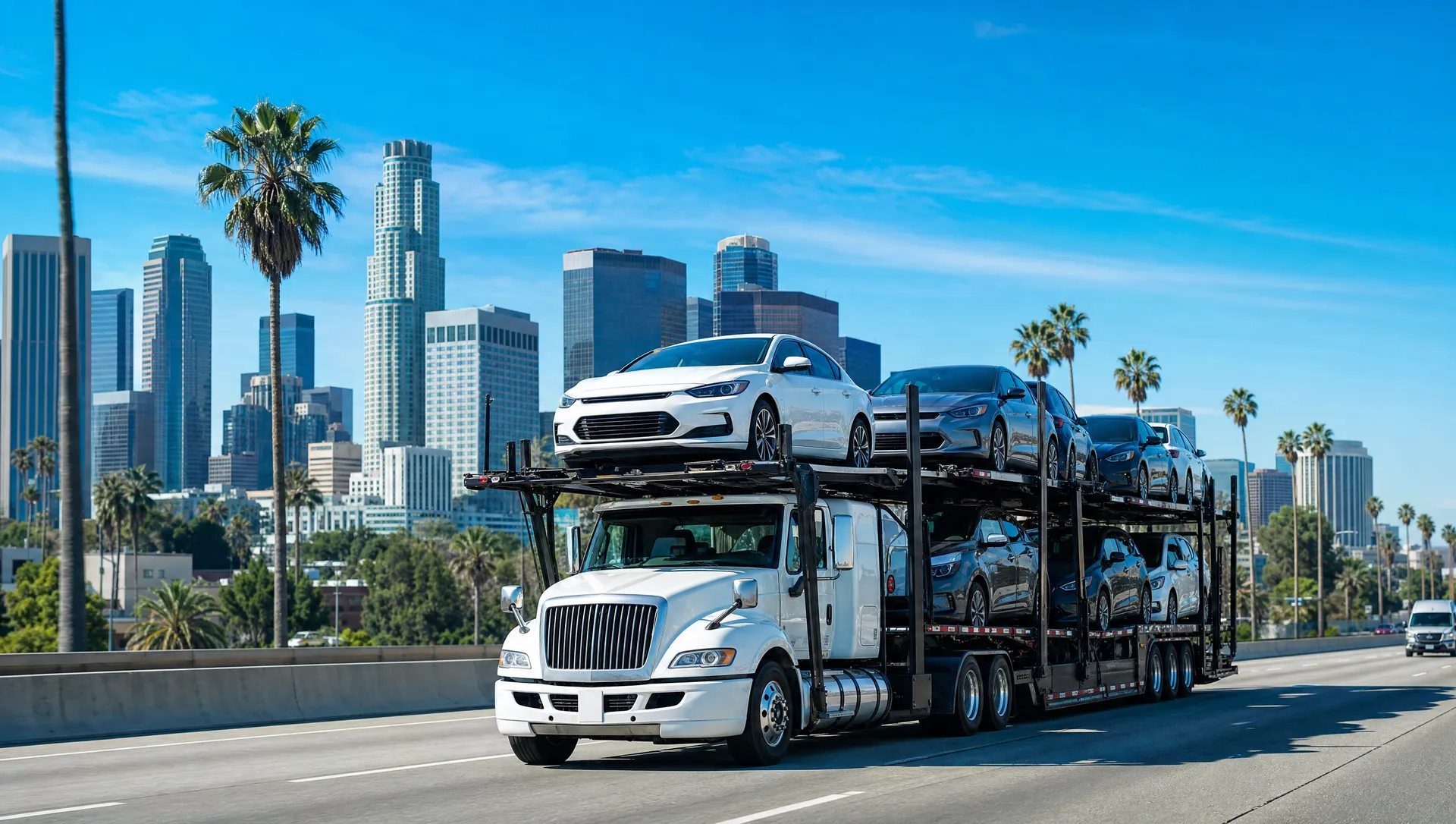
Published estimates for shipping a car from Miami to Los Angeles ranged $949–$2,667 (standard sedan, open transport, published route estimates), and transit is commonly 7–10 days once loaded.
Know this first: Both endpoints are meeting-point cities — expect the handoff near a freeway rather than at the curb in Brickell or Silver Lake.
Commonly quoted at 7–10 days once loaded. The route covers about 2,730 driving miles.
I-10 essentially end to end — Jacksonville to the LA basin on one interstate.
Steady year-round with a modest summer peak. Hurricane season can slow the Florida end June through November; the desert crossing is all-weather.
Published third-party estimates ranged $949–$2,667 (standard sedan, open transport, published route estimates, collected August 2026). A true 2,700-mile run priced by the cross-country market: open transport for a running car is the baseline, enclosed is a meaningful step up, and summer moving season firms both. Meeting-point deliveries at each end keep quotes honest.
Published estimates collected · standard sedan, open transport, published route estimates
Published estimates
$949–$2,667
$949–$1,149
as published by SGT Auto Transport (opens in a new tab)
5–7 days (published as 2025 market conditions)
$1,634–$2,667
as published by Freightwaves Checkpoint (opens in a new tab)
2,734 miles, 7–15 days (August 2026)
$1,399
as published by moveBuddha (opens in a new tab)
headline estimate, 2026 cost page
Broker route tables tend to publish lower figures than editorial estimators on the same lane — which is exactly why every figure here is shown with its source.
These figures are estimates published by third-party transport companies, shown here for orientation with their sources and collection date. They are not quotes from Car Shipping Miami or from providers on this marketplace, and they are not binding on anyone. Independent providers set their own pricing for your specific shipment.
| Pickup | Delivery | Approx. road miles | Typical transit |
|---|---|---|---|
| Miami, FL | Los Angeles, CA | ~2,800 mi | Commonly quoted at 7–10 days once loaded |
| Fort Lauderdale, FL | Los Angeles, CA | ~2,790 mi | Commonly quoted at 7–10 days once loaded |
| West Palm Beach, FL | Los Angeles, CA | ~2,780 mi | Commonly quoted at 7–10 days once loaded |
| Miami, FL | Long Beach, CA | ~2,795 mi | Commonly quoted at 7–10 days once loaded |
Distances are approximate road miles estimated from city centers (GeoNames postal data, CC BY 4.0) and set expectations only. Transit is the window providers commonly quote once the vehicle is moving.
Sourced data
Every figure below names its source — the standard the whole site holds itself to.
≈50,000
Californians moved to Florida in 2022 — the current runs both ways
Source: U.S. Census Bureau, state-to-state migration estimates (2022)
2,460 mi
I-10 end to end — the interstate this lane essentially is
Source: Federal Highway Administration

Both ZIP codes, the year, make and model, whether it runs, and your timing — about a minute, contact details last.

Independent providers that actually run this lane respond with real numbers by phone, text or email.

Condition is documented at pickup, the car rides the corridor, and you inspect again before signing at delivery.
How this route behaves
Both endpoints are dense, carrier-hostile cities where a 75-foot rig cannot reach many residential streets. On both ends, expect a meeting point near a freeway — locals treat this as normal, and it is faster for everyone than attempting a curbside drop in Brickell or Silver Lake.
Because collector, exotic and film-industry vehicles move constantly between South Florida and LA, enclosed carriers run this corridor at volume rare for a 2,700-mile lane. If the car warrants covered transport, this is one of the easier routes in the country to arrange it.
A week-plus on a truck means weather, hours-of-service limits and other customers’ schedules all touch your delivery. Providers quote ranges because ranges are the truth — plan the far end of the window and be pleasantly surprised.
Providers on this corridor commonly collect across Miami-Dade, Broward and Palm Beach counties — Miami, Hialeah, Coral Gables, Fort Lauderdale, Hollywood, Pompano Beach, Boca Raton and West Palm Beach. Where a full-size carrier cannot reach the address, drivers arrange a nearby lot with room to load.
Tell us where the car is now and where it’s going — providers running this route can quote it.
Common questions
Commonly quoted at 7–10 days once loaded. The route covers about 2,730 driving miles.
Steady year-round with a modest summer peak. Hurricane season can slow the Florida end June through November; the desert crossing is all-weather.
Published third-party estimates ranged $949–$2,667 (standard sedan, open transport, published route estimates, collected August 2026). A true 2,700-mile run priced by the cross-country market: open transport for a running car is the baseline, enclosed is a meaningful step up, and summer moving season firms both. Meeting-point deliveries at each end keep quotes honest.
If the car warrants it, this is one of the easiest routes in the country to arrange it — collector and industry traffic between South Florida and LA keeps enclosed carriers running the corridor at unusual volume.
It’s a window, honestly quoted as one — weather, driver hours-of-service and other customers all touch a 2,700-mile schedule. Plan around the far end and be pleasantly surprised.
Generally yes — providers quote door-to-door as the default. The practical caveat is the truck: a full-size carrier cannot always work a narrow street, a gated community or a low garage, so drivers often agree a nearby lot with room to load. That is normal and is not a downgrade in service.
Open transport is the standard for everyday vehicles and the least expensive option, which is why most shipments use it. Enclosed transport costs meaningfully more and suits show-condition, classic, exotic or freshly painted cars where weather and road exposure are not acceptable.
A week or two of lead time with a flexible first-available date is the comfortable zone on a major corridor. During seasonal peaks — snowbird season on Florida lanes especially — booking earlier matters more than negotiating harder.
That depends entirely on the provider. Many allow a limited amount below the window line; some allow none. Items left in the vehicle are generally not covered by the carrier’s cargo insurance, so confirm the policy before pickup day.
Distances and transit ranges describe how these routes typically behave. They are not quotes, and they are not a commitment by Car Shipping Miami or any provider. Import duties, taxes and vehicle-eligibility rules are set by governments and change — confirm current requirements before booking any ocean or international shipment. The provider you speak with gives the estimate that applies to your shipment.
Car Shipping Miami is a marketplace and advertising platform. Car Shipping Miami does not transport vehicles or provide transportation services. Transportation quotes and services are offered by independent providers. Review provider information and terms before choosing a service. How this marketplace works
Share the route, the vehicle and your timing. You’ll know exactly what happens next before you submit anything.
Get quotesCar Shipping Miami is a marketplace. Independent providers quote and perform the transport.